About the Artist
Joel Oswaggo was born in 1944 in Kamagambo, South Nyanza, Kenya.
He belongs to an earlier generation of self-taught pioneers in Kenya’s art scene, who were promoted and marketed by the curator of Gallery Watatu, the late Ruth Schaffner, in the 1980s and 1990s.
Joel Oswaggo started his artist career in 1968 as a sign board painter for a big business company in Uganda. In the early 1970s, during the regime of Idi Amin, he left Uganda and returned to Kenya.
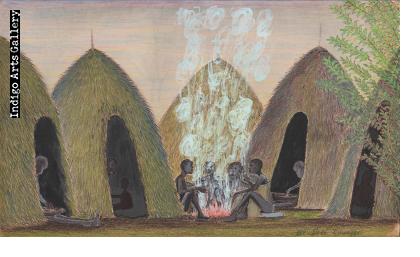
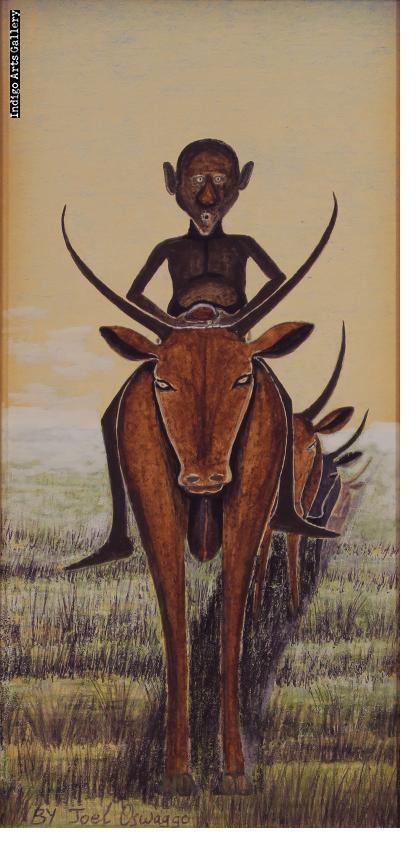
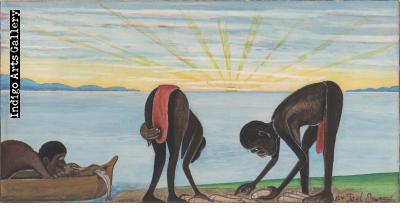
Joel Oswaggo is well known for his unique artistic style: colour pencil drawings on paper, over the years becoming more and more meticulously elaborated, narrating the disappearing legend and cultural tradition of his Luo community in a hyper-realistic and grotesque style.
His images of traditional life never describe a perfect world – poverty, hunger, disease and death are present in most of his drawings. He lives and works as a freelance artist in his home community in north-western Kenya.
(biography courtesy of Red Hill Gallery)
Born in 1944 in South Nyanza, Joel Oswaggo began drawing as a boy, replicating illustrations from schoolbooks onto the walls of his home. Growing up during a period of cultural transition among the Luo, his work became a visual record of traditions under pressure from rapid social change. Oswaggo emerged in the 1980s and 1990s as part of a generation of self-taught pioneers in Kenya’s art scene. He was among the artists supported by Gallery Watatu and its curator Ruth Schaffner, who recognised the cultural significance of his work.
Oswaggo began his career in 1968 as a signboard painter in Uganda before returning to Kenya in the early 1970s during the Idi Amin regime. From this foundation, he developed a distinct visual language rooted in colour pencil drawings on paper—meticulously detailed, evolving over time into complex compositions. His work documents the legends, rituals, and everyday realities of the Luo community. Rendered in a hyper-real, at times grotesque style, his images resist idealisation, foregrounding themes of poverty, hunger, illness, and mortality alongside cultural continuity.
Working as a freelance artist within his home community, Oswaggo’s practice remains a vital record of lived experience and a testament to the role of art in preserving memory amid change.
(Above biography courtesy of East African Museum of Art - Nairobi, Kenya)