I will be out of the country for about six weeks, from May 1st to June 17th, and so will not be shipping orders or open for visitors at the gallery after April 27. The Indigo Arts website will be active as always. Because I will be traveling in a remote area I will not have email or phone access for most of the time. I will respond to messages as soon as possible. I will be able to process and ship orders after June 17th, 2026. Thank you for your patience.
Namaste!

Please Note:
Our Shopping Cart is broken, such that customers encounter an error message and so have not been able complete purchases. Until the redesign is complete, please send us a message through the "Contact Us" form or leave a phone message at 215-765-1041. Let us know the item(s) you are trying to purchase and your contact information, including shipping address. We will send you a separate invoice that you may pay by credit card, Paypal, Venmo etc.. Thank you for your patience!

Politics, History, Current Events

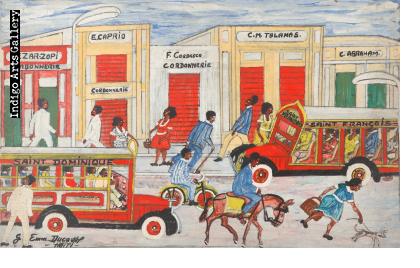
Port-au-Prince Street Scene
SKU: GED-2301

Oil and acrylic on board (16" x 26"), c.1960s.
From private collection.

Price on Request

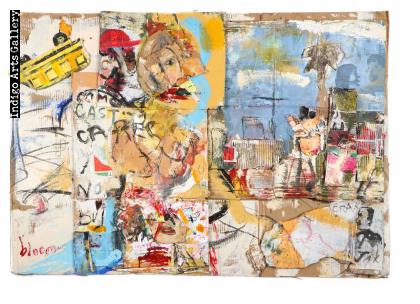
Comcast Cares
SKU: JMBL-2401

Jim Bloom (American, b. 1968)
"Comcast Cares", mixed media painting, signed. Unframed.
Size: 38'' x 54'', 97 x 137 cm (irregular).

Price on Request

FANFARE DES ELEVES DU LYCEE ANTENOR FIRMIN CELEBRANT, LE 17. OCT.
SKU: GED-2501

Oil and acrylic on board (16" x 25"), c.1960s. Framed.
From private collection.

Price on Request

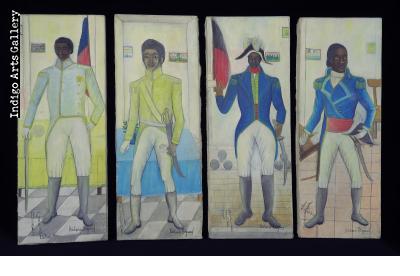
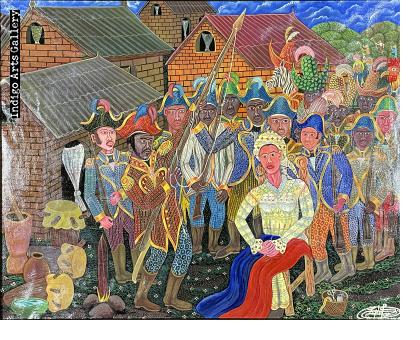
Hommage et Gloire Aux Femmes de Notre Histoire (Tribute and Glory to the Women of Our History)
SKU: FZ-2502

Acrylic on canvas (24" x 30"), c.2000. Framed. Text on back reads: "Hommage et Gloire Aux Femmes de Notre Histoire (Tribute and Glory to the Women of Our History) : “La Creation du drapeau Haïtien le 18 Mai, 1803 par Jean Jacques Dessalines Cousu par Catherine Flon en presence des Generaux Petion, Christophe, Capois, Boirond, etc."

Per Wikipedia: Catherine Flon (1772-1831) was a Haitian seamstress, patriot and national heroine. She is regarded as one of the symbols of the Haitian Revolution and independence. She is celebrated for sewing the first Haitian flag on May 18, 1803, and maintains an important place in Haitian memory of the Revolution to this day.
 Catherine Flon was born on December 2, 1772, in Arcahaie in Saint-Domingue. Her parents traded in textiles from France. She became a seamstress with her own workshop, and had several apprentices. She was the god daughter of Jean-Jacques Dessalines.
According to Haitian revolutionary tradition, Flon created the country's first flag on May 18, 1803, the last day of the Congress of Arcahaie. There, the leader of the Revolution, Jean-Jacques Dessalines, Flon's godfather, cut apart a French tricolor with his sabre, demonstrating his desire to break away from France. He gave the pieces to Flon, who stitched them back together, while leaving out the central white strip. In Haitian lore, the colors of the new flag took on a racialized meaning: the blue and red stripes represented a union between the black and mulatto citizens of Haiti.
Historians have noted some limitations within this legendary history of the flag's creation. For instance, primary sources from the Revolution reveal that rebels had used blue-and-red flags before the Arcahaie conference. Also, the first Haitians to use the bicolor flag had meant it to represent an extension of French Revolutionary values, rather than a rejection of them; early revolutionaries had fought to preserve the 1794 law of emancipation rather than to gain independence.

Price on Request

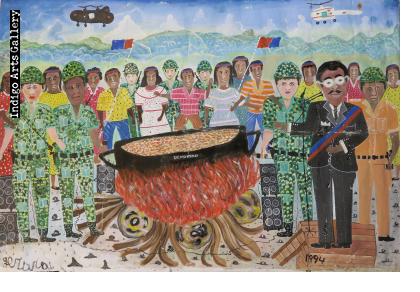
Demokrasi
SKU: GF-1710

Oil and latex paint on "canvas" (39 1/4” x 59 1/2”), 1994.  
Vintage Gerard from a private collection.
Note:  Painting suffered in several years of storage by the artist (as described below) and has some areas of cracking and chipping of the paint.  Restoration work is recommended once painting is stretched.  Painting will be shipped rolled.

The owner of the painting provides the following notes on its subject and history:
Painted in 1994.  Bought in March 2007.  Gerard repainted some damaged areas prior to sale in 2007.  Artist put date (1994) on painting at the request of Jean Marie Bien Aimé.  The painting is a visual of an Aristide slogan whereby everyone in a democracy is able to share at the bountiful table.  The US soldiers (not UN) are Aristide's helpful agents in the desire for democratization of Haiti, where everyone has a place.  
When the painting was bought Gerard still maintained his support for Aristide.  He had hid the painting because he felt that his political opinion was dangerous.  The different political factions violence has been omnipresent on the Haitian landscape.


Price on Request